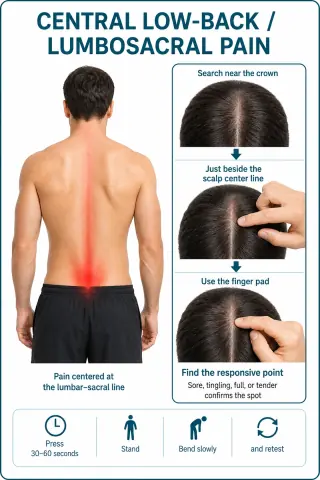
Back & shoulder · Guided pressure check
Back Pain: Thumb-Side Forearm Pressure
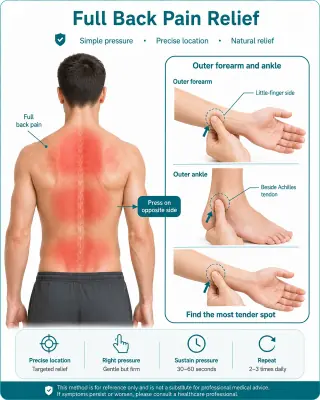
For mid-back discomfort, using the thumb-side forearm line on the opposite side while repeating the affected movement.
Full editorial guide. Educational use. Not clinically reviewed.
Guided check · 4–6 minutes
Find the point. Press. Move. Retest.
Use the marked area exactly as shown. Keep pressure on the responsive point while repeating the same movement.
Thumb-side line of the opposite forearm
Use the forearm on the opposite side of the back pain. Search along the thumb-side line from the elbow crease down to the wrist crease; do not rely on one fixed point.
A local sore, tingling, full, or tender feeling under pressure is the expected point response. Spend more time on the most responsive point along the line.- 01
Find the forearm line
Use the forearm opposite the back pain. Search the thumb-side line from the elbow crease to the wrist crease, section by section.
- 02
Choose the responsive point
Press along the line in small sections for 30–60 seconds and spend more time where the local point response is strongest.
- 03
Move the back gently
Keep pressure on that point while slowly bending forward, rotating the torso, or gently arching the back.
- 04
Search and retest
If only part of the pain improves, search slightly above or below the forearm point, then repeat the same back movement.
Quick retest
How did the same easy movement feel?
Need more context?
Safety, meaning, and sources.
The quick check is above. Open these sections only when you want the reasoning or need to decide whether the routine fits.
Is this a reasonable self-check for me?+
May fit when
- The feeling is mild and linked to prolonged sitting or ordinary movement.
- You can walk, breathe, and move normally.
- There is no recent major strain, fall, or illness.
Skip it when
- Back pain comes with chest pain, breathing trouble, abdominal pain, faintness, or fever.
- There is new leg weakness, groin numbness, or loss of bladder or bowel control.
- Pain followed significant trauma or is severe and unexplained.
What should I notice before and after?+
Baseline movement
Use only a small, comfortable motion. The purpose is comparison, not stretching.
- Turn the torso a few degrees left and right.
- Gently round and then return the upper back.
- Take one comfortable deep breath.
Interpretation
- A temporary change does not identify the cause of back pain.
- No change is useful information and a reason not to keep searching aggressively.
- Repeated or unexplained back pain should be discussed with a qualified clinician.
Break up long sitting periods, use comfortable movement, and avoid pressing the forearm until it becomes bruised or sore.
Why are the claims deliberately limited?+
This page is for mild mid-back tightness that changes with posture or a small turn. Back pain has many possible causes, so a pressure point cannot diagnose what is happening.
The routine uses a line rather than a single “magic” point. You will scan a short part of the opposite forearm, select one tolerable tender area, and compare the same back movement before and after.
The source demonstration uses acupuncture. This page preserves its side relationship, selected body region, point-search method, and movement check while adapting the contact method to finger pressure. Finger pressure is not presented as medically equivalent to acupuncture.
Finger pressure is an editorial adaptation. It is not presented as medically equivalent to acupuncture.
Red flags and public-health references+
Call emergency services for severe or life-threatening symptoms. In the United States, call 911.
- Back Pain MedlinePlus, U.S. National Library of Medicine
- Acupuncture: Effectiveness and Safety National Center for Complementary and Integrative Health