Arm & hand · Guided pressure check
Chronic Wrist Pain
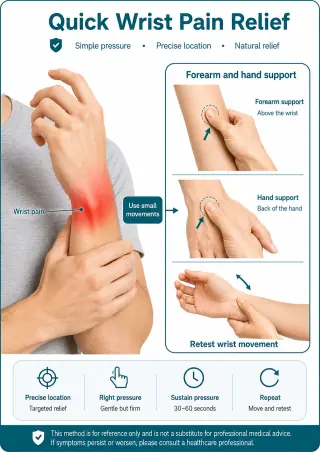
For long-term wrist discomfort or stiffness, using a responsive point at the opposite front-inner ankle.
Full editorial guide. Educational use. Not clinically reviewed.
Guided check · 4–6 minutes
Find the point. Press. Move. Retest.
Use the marked area exactly as shown. Keep pressure on the responsive point while repeating the same movement.
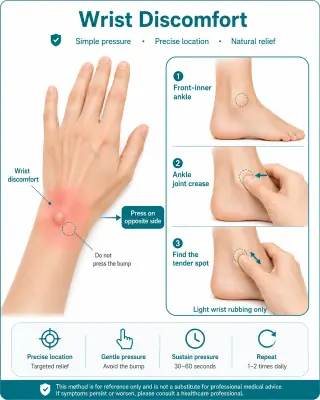
Front-inner ankle on the opposite side
Use the ankle opposite the painful wrist. Search the front-inner ankle and ankle-joint crease, just in front of the inner ankle bone, until you find the most responsive point.
A local sore, tingling, full, or tender feeling under pressure is the expected point response and helps confirm that you found the right spot.- 01
Use the opposite ankle
For right-wrist pain, use the left ankle; for left-wrist pain, use the right ankle. Search the marked front-inner ankle area.
- 02
Find the responsive point
Press slowly around the ankle-joint crease until one point produces the clearest local sore, tingling, full, or tender response.
- 03
Press and move the wrist
Hold that point with steady, firm pressure for 30–60 seconds while gently circling or bending the painful wrist.
- 04
Retest and repeat
Release and repeat the same wrist movement. Search nearby and repeat 2–3 rounds when more relief is needed.
Quick retest
How did the same easy movement feel?
Need more context?
Safety, meaning, and sources.
The quick check is above. Open these sections only when you want the reasoning or need to decide whether the routine fits.
Is this a reasonable self-check for me?+
May fit when
- The wrist feels mildly stiff after repetitive, ordinary activity.
- Grip and finger movement are normal for you.
- There is no recent fall, swelling, bruising, or new tingling.
Skip it when
- Pain followed a fall onto the hand or a forceful twist.
- There is new numbness, tingling, loss of grip, or fingers changing color.
- The wrist is hot, red, markedly swollen, deformed, or increasingly painful.
What should I notice before and after?+
Baseline movement
Keep the forearm supported and choose the smallest movement that shows the stiffness.
- Turn the palm up and down.
- Bend the wrist gently forward and back.
- Open and close the hand without squeezing.
Interpretation
- A brief comfort change is not proof that the wrist problem has resolved.
- Symptoms that return with the same task may call for workload, rest-break, or ergonomic changes.
- Night numbness, progressive weakness, or persistent pain needs professional evaluation.
Give the wrist a short break from the task that triggered it. Keep any later movement easy and avoid forceful stretching immediately after pressure.
Why are the claims deliberately limited?+
Typing, gripping, tools, sport, and many medical conditions can all produce wrist discomfort. This routine is only for mild, familiar stiffness that is not associated with a recent fall or new numbness.
The wrist contains several small joints plus tendons, ligaments, and nerves. Use broad, moderate pressure and a small movement. Sharp or electric sensations are a stop signal, not a target.
The source demonstration uses acupuncture. This page preserves its side relationship, selected body region, point-search method, and movement check while adapting the contact method to finger pressure. Finger pressure is not presented as medically equivalent to acupuncture.
Finger pressure is an editorial adaptation. It is not presented as medically equivalent to acupuncture.
Red flags and public-health references+
Call emergency services for severe or life-threatening symptoms. In the United States, call 911.
- Wrist Injuries and Disorders MedlinePlus, U.S. National Library of Medicine
- Acupuncture: Effectiveness and Safety National Center for Complementary and Integrative Health