Neck & head · Guided pressure check
Neck, Shoulder + Spine Pain
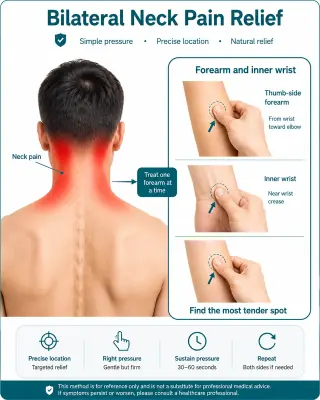
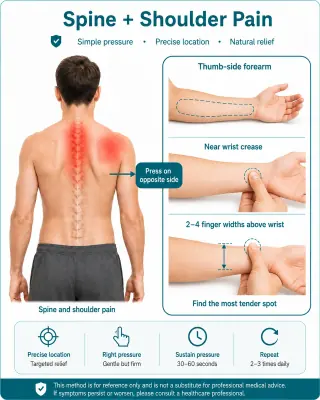
For combined neck, shoulder, and spinal discomfort, especially when several areas feel connected during movement.
Source field note. Kept available for readers, excluded from search and advertising while editorial work continues.
Guided check · 3–5 minutes
Find the point. Press. Move. Retest.
Use the marked area exactly as shown. Keep pressure on the responsive point while repeating the same movement.
Find the most responsive pressure point
Search the wrist, forearm, or head area for the most tender point that relates to your discomfort.
A local sore, tingling, full, or tender feeling at the pressure point is normal, counts as an effective point response, and confirms that you found the right spot.- 01
Choose one main movement
Select the movement that bothers you most (neck turn, shoulder lift, or spinal bend) to focus on first.
- 02
Find the most responsive pressure point
Search the wrist, forearm, or head area for the most tender point that relates to your discomfort.
- 03
Press and move
Apply steady pressure while slowly performing the uncomfortable movement to help ease tension.
- 04
Safety note
Stop if pain increases. Do not force any movement that causes sharp discomfort.
Quick retest
How did the same easy movement feel?
Need more context?
Safety, meaning, and sources.
The quick check is above. Open these sections only when you want the reasoning or need to decide whether the routine fits.
Is this a reasonable self-check for me?+
May fit when
- For combined neck, shoulder, and spinal discomfort, especially when several areas feel connected during movement.
- You can repeat the source demonstration's comparison slowly: Select the movement that bothers you most (neck turn, shoulder lift, or spinal bend) to focus on first.
Skip it when
- Stop if pain increases.
- Do not force any movement that causes sharp discomfort.
What should I notice before and after?+
Baseline movement
Repeat the choose one main movement once before pressure, then use that exact movement for the retest.
- Select the movement that bothers you most (neck turn, shoulder lift, or spinal bend) to focus on first.
Interpretation
- Use the choose one main movement as the before-and-after reference. If it feels easier, remember the responsive point and finish or repeat as written above.
- If the neck, shoulder + spine pain feels unchanged, search only within the marked area for a clearer sore, tingling, full, or tender point.
Release the point, repeat the choose one main movement once, and compare it with the starting movement.
Why are the claims deliberately limited?+
For combined neck, shoulder, and spinal discomfort, especially when several areas feel connected during movement.
The source demonstration uses acupuncture. This page preserves its side relationship, selected body region, point-search method, and movement check while adapting the contact method to finger pressure. Finger pressure is not presented as medically equivalent to acupuncture.
Finger pressure is an editorial adaptation. It is not presented as medically equivalent to acupuncture.
Red flags and public-health references+
Call emergency services for severe or life-threatening symptoms. In the United States, call 911.
- Back Pain MedlinePlus, U.S. National Library of Medicine
- Acupuncture: Effectiveness and Safety National Center for Complementary and Integrative Health