Back & shoulder · Guided pressure check
Shoulder Joint Pain
For shoulder discomfort or limited movement, using responsive points in the opposite inner-ankle hollow.
Full editorial guide. Educational use. Not clinically reviewed.
Guided check · 3–5 minutes
Find the point. Press. Move. Retest.
Use the marked area exactly as shown. Keep pressure on the responsive point while repeating the same movement.
Front-inner ankle, opposite side
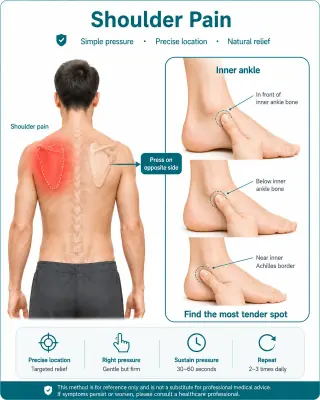
Use the inner ankle on the opposite side of the painful shoulder. Find the hollow in front of the inner ankle bone, near the gap between the bone and tendon.
A local sore, tingling, full, or tender feeling under pressure is the expected point response. Choose the point that also makes the shoulder move more easily.- 01
Locate the inner-ankle hollow
Find the responsive spot in front of the inner ankle bone on the side opposite the painful shoulder.
- 02
Press in slowly
Use your thumb to press gently into the ankle-joint space. Start light and gradually increase to a firm, usable pressure.
- 03
Move the shoulder joint
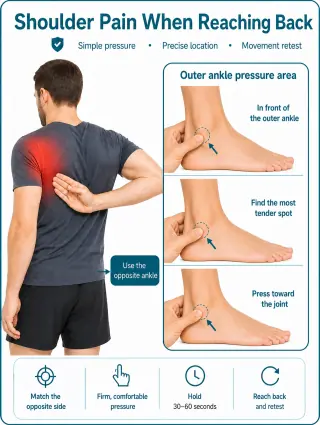
Hold for about 60 seconds while slowly raising the arm, moving it out to the side, or reaching behind the back.
- 04
Search and repeat
If pain remains, search slightly above or below the same inner-ankle area. Press each responsive point for 30–90 seconds and repeat 2–3 rounds if comfortable.
Quick retest
How did the same easy movement feel?
Need more context?
Safety, meaning, and sources.
The quick check is above. Open these sections only when you want the reasoning or need to decide whether the routine fits.
Is this a reasonable self-check for me?+
May fit when
- The shoulder feels mildly stiff after ordinary use.
- You can still lift and lower the arm under your own control.
- The sensation is familiar and has not followed a recent injury.
Skip it when
- The shoulder looks deformed, feels dislocated, or cannot support the arm.
- Pain followed a fall, forceful pull, or impact.
- There is marked swelling, redness, fever, new weakness, or numbness.
What should I notice before and after?+
Baseline movement
Pick the safest movement that shows the restriction and use the same movement throughout.
- Raise the arm forward only to a comfortable height.
- Slide the hand toward the opposite shoulder.
- Reach behind the back without forcing.
Interpretation
- A small change is enough to record; more pressure is not automatically better.
- If only one direction remains limited, stop instead of testing many new points.
- Persistent shoulder restriction deserves assessment because tendons, the joint, and the neck can produce similar symptoms.
Resume comfortable activity. If you choose to repeat the routine, wait until later in the day and keep the total pressure time short.
Why are the claims deliberately limited?+
Shoulders can feel stiff for many reasons, and the location of pain does not identify the cause. This routine is limited to mild, familiar discomfort during an ordinary movement such as reaching overhead or behind the back.
You will choose one movement, keep its range consistent, and retest after gentle pressure. That makes the routine a small observation exercise rather than a promise of treatment.
The source demonstration uses acupuncture. This page preserves its side relationship, selected body region, point-search method, and movement check while adapting the contact method to finger pressure. Finger pressure is not presented as medically equivalent to acupuncture.
Finger pressure is an editorial adaptation. It is not presented as medically equivalent to acupuncture.
Red flags and public-health references+
Call emergency services for severe or life-threatening symptoms. In the United States, call 911.
- Shoulder Injuries and Disorders MedlinePlus, U.S. National Library of Medicine
- Acupuncture: Effectiveness and Safety National Center for Complementary and Integrative Health