Back & shoulder · Guided pressure check
Upper Back / Shoulder Blade Area Pain
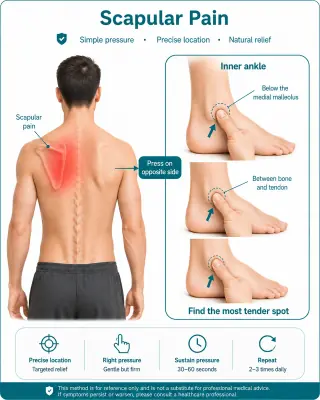
For tightness or pulling pain around the upper back and shoulder blade, using responsive points in the opposite inner ankle.
Full editorial guide. Educational use. Not clinically reviewed.
Guided check · 3–5 minutes
Find the point. Press. Move. Retest.
Use the marked area exactly as shown. Keep pressure on the responsive point while repeating the same movement.
Opposite inner-ankle hollow
Use the inner ankle on the opposite side of the pain. Look for the hollow where the front of the inner ankle meets the top of the foot. Search slowly around the edge of the bone and nearby tendons until you find the most responsive spot.
A local sore, tingling, full, or tender feeling under pressure is the expected point response and helps confirm that you found the right spot.- 01
Find the pressure area
For one-sided pain, use the opposite side: right-side pain, left ankle; left-side pain, right ankle. Find the most responsive point inside the marked inner-ankle area.
- 02
Press while moving the shoulder
Use your thumb to press into the hollow toward the ankle joint. Hold for about 60 seconds while slowly raising or rotating the shoulder, or repeating the movement that normally causes discomfort.
- 03
Search nearby if needed
If the pain improves but does not fully settle, search within 1–2 cm around the same ankle area for another responsive point and repeat.
- 04
Repeat
Press each point for 30–90 seconds. Repeat 2–3 rounds if comfortable, checking the same shoulder movement after each round.
Quick retest
How did the same easy movement feel?
Need more context?
Safety, meaning, and sources.
The quick check is above. Open these sections only when you want the reasoning or need to decide whether the routine fits.
Is this a reasonable self-check for me?+
May fit when
- The discomfort is mild, familiar, and linked to posture or ordinary activity.
- You can move the arm and shoulder without sudden weakness or instability.
- There is no recent fall, impact, fever, chest pain, or shortness of breath.
Skip it when
- Pain began after a fall, collision, or forceful lift.
- You have chest pressure, trouble breathing, sweating, dizziness, or pain spreading to the jaw or arm.
- There is new numbness, weakness, fever, rash, marked swelling, or steadily worsening pain.
What should I notice before and after?+
Baseline movement
Choose one ordinary movement that clearly reproduces the tight feeling without forcing it.
- Slowly raise the affected arm.
- Gently roll the shoulder backward.
- Turn the upper body a few degrees each way.
Interpretation
- Easier movement: stop after one or two rounds and note how long the change lasts.
- No change: do not keep increasing pressure. Try ordinary rest, gentle movement, or professional advice if the problem persists.
- Worse, sharper, numb, or unstable: stop the routine.
Avoid repeatedly testing the sore movement for the rest of the hour. Return to normal light activity, and reassess later rather than pressing continuously.
Why are the claims deliberately limited?+
This guide is for mild, familiar tightness around the shoulder blade—such as a pulling feeling after desk work, driving, or a long day using one arm. It starts with a simple movement check, then pairs that same movement with gentle pressure at the opposite inner ankle.
The goal is observation, not a dramatic result. A useful session may simply help you notice which motion feels limited, whether the sensation changes, and when self-care is not the right choice.
The source demonstration uses acupuncture. This page preserves its side relationship, selected body region, point-search method, and movement check while adapting the contact method to finger pressure. Finger pressure is not presented as medically equivalent to acupuncture.
Finger pressure is an editorial adaptation. It is not presented as medically equivalent to acupuncture.
Red flags and public-health references+
Call emergency services for severe or life-threatening symptoms. In the United States, call 911.
- Shoulder Injuries and Disorders MedlinePlus, U.S. National Library of Medicine
- Acupuncture: Effectiveness and Safety National Center for Complementary and Integrative Health